
🌾 Why Solar Water Pumps Matter
In Sarawak’s rural and interior regions — from Sri Aman to Kapit and Baram — many farms operate far from the main electricity grid. Diesel pumps are costly and unreliable, especially during monsoon seasons. Off‑grid solar water pumps offer a clean, low‑maintenance alternative that harnesses Sarawak’s abundant sunlight to power irrigation, livestock watering, and aquaculture systems.
⚙️ System Overview
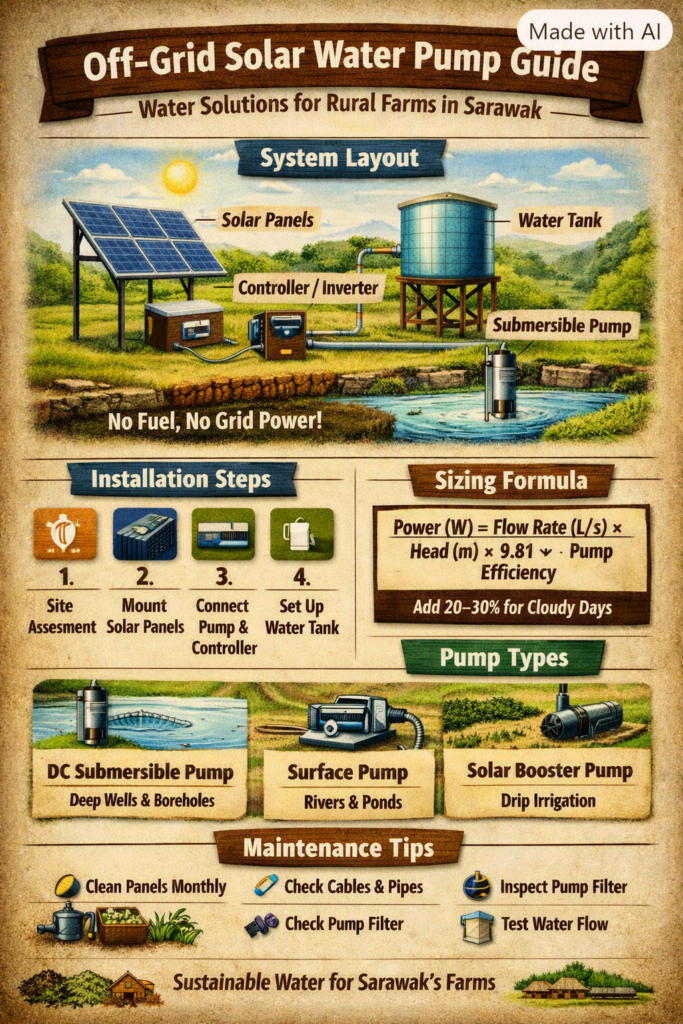
A solar water pump converts sunlight into electrical energy to drive a motor that lifts or circulates water. The system typically includes:
| Component | Function |
|---|---|
| Solar Panels | Capture sunlight and generate DC electricity. |
| Controller/Inverter | Regulates voltage and converts DC to AC (if needed). |
| Pump Unit | Submersible or surface pump that moves water. |
| Storage Tank | Holds water for use during cloudy or nighttime hours. |
| Mounting Structure | Positions panels at optimal tilt (10–15° for Sarawak). |
🧭 Step‑by‑Step Installation Guide
1. Site Assessment
- Measure daily water demand (liters/day).
- Identify water source — river, borehole, or pond.
- Ensure solar exposure: at least 5–6 hours of direct sunlight daily.
- Avoid shading from trees or hills.
2. System Sizing
Use this simplified formula for solar pump sizing:
Example: For a 1 L/s flow at 10 m head with 60% efficiency →
Add 20–30% buffer for cloudy conditions.
3. Panel Installation
- Mount panels facing south‑southwest for optimal exposure.
- Use galvanized frames or bamboo structures for cost‑effective setups.
- Keep panels clean and tilted to prevent dust and water pooling.
4. Pump Connection
- Connect controller to panels and pump using waterproof cables.
- Test voltage output before connecting the pump.
- Install a non‑return valve to prevent backflow.
5. Water Storage & Distribution
- Use elevated tanks (2–3 m height) for gravity‑fed irrigation.
- Include drip or sprinkler systems for efficient water use.
- Add float switches to prevent dry running.
🔋 Maintenance Tips
- Clean panels monthly to remove dust and bird droppings.
- Check cable insulation and connectors for corrosion.
- Inspect pump filters and impellers every 3 months.
- Replace worn seals promptly to prevent leaks.
🌿 Advantages for Sarawak Farmers
- Zero fuel cost — sunlight is free.
- Low maintenance — fewer moving parts than diesel pumps.
- Reliable in remote areas — no dependence on grid power.
- Scalable — systems can expand with farm growth.
- Eco‑friendly — reduces carbon footprint and noise pollution.
🧩 Recommended Pump Types
| Pump Type | Ideal Use | Example Capacity |
|---|---|---|
| DC Submersible Pump | Deep wells, boreholes | 0.5–2 L/s |
| Surface Centrifugal Pump | Rivers, ponds | 1–5 L/s |
| Solar Booster Pump | Drip irrigation | 0.2–1 L/s |
🏁 Closing Note
Off‑grid solar water pumps are transforming Sarawak’s interior agriculture — from pepper farms in Serian to paddy fields in Simunjan. With proper sizing, installation, and maintenance, farmers can achieve year‑round water reliability while cutting operational costs.
SarawakAgro.com continues to promote renewable energy solutions that empower rural communities toward sustainable farming futures.