
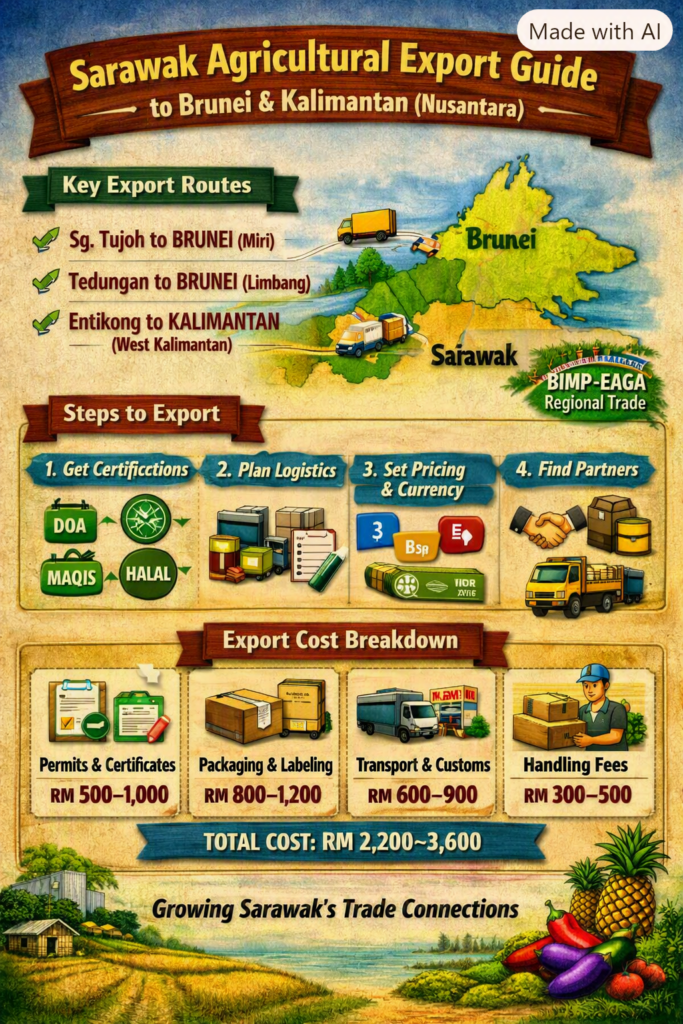
🌾 Why Regional Export Matters
Sarawak’s agriculture is strategically positioned for regional trade. With Brunei Darussalam to the north and Kalimantan (Indonesia’s Nusantara capital region) to the south, Sarawak farmers and agro‑SMEs have direct access to two fast‑growing markets. Exporting to these neighbors strengthens:
- Income diversification for local producers.
- Market resilience beyond domestic demand.
- Regional food security cooperation under BIMP‑EAGA (Brunei‑Indonesia‑Malaysia‑Philippines East ASEAN Growth Area).
🧭 Step‑by‑Step Export Guide
Step 1: Identify Eligible Products
Sarawak’s export‑ready produce includes:
- Fresh fruits & vegetables: pineapple, banana, chili, eggplant, cucumber.
- Processed foods: dried pepper, sauces, pickles, frozen seafood.
- Livestock & aquaculture products: tilapia, catfish, poultry feed.
- Agro‑based products: coconut oil, honey, herbal supplements.
Check with the Sarawak Department of Agriculture (DOA) and Malaysian Quarantine and Inspection Services (MAQIS) for product eligibility and phytosanitary requirements.
Step 2: Obtain Export Certification
Before shipment, exporters must secure:
- DOA Export Permit — verifies product origin and quality.
- MAQIS Certificate — ensures compliance with plant and animal health standards.
- Halal Certification (JAKIM or Sarawak Islamic Council) — required for Brunei and Indonesian Muslim markets.
- Food Safety Certification (MeSTI or HACCP) — for processed goods.
💡 Tip: Register your business with MATRADE (Malaysia External Trade Development Corporation) to access export training and trade fairs.
Step 3: Understand Border Logistics
| Border Point | Destination | Key Agencies | Notes |
|---|---|---|---|
| Sungai Tujoh (Miri–Brunei) | Brunei Darussalam | Customs, MAQIS, DOA | Ideal for fresh produce and small consignments. |
| Tedungan (Limbang–Brunei) | Brunei Darussalam | Customs, MAQIS | Common for livestock and processed food. |
| Entikong (Serian–West Kalimantan) | Indonesia | Customs, MAQIS, DOA | Main route for bulk shipments to Pontianak and Nusantara region. |
Ensure proper documentation and cold‑chain logistics for perishable goods.
Step 4: Pricing & Currency Considerations
- Brunei Dollar (BND) is pegged to the Singapore Dollar — stable for trade.
- Indonesian Rupiah (IDR) fluctuates more; use forward contracts or bank hedging for large deals.
- Include transport, customs fees, and certification costs in your pricing model.
Step 5: Build Partnerships
- Collaborate with Sarawak Trade & Tourism Office (STATOS) for export promotion.
- Join BIMP‑EAGA trade missions to connect with distributors in Brunei and Kalimantan.
- Partner with local cooperatives for volume consolidation and shared logistics.
📦 Example Export Cost Breakdown (Per Shipment)
| Item | Estimated Cost (RM) |
|---|---|
| Certification & permits | 500–1,000 |
| Packaging & labeling | 800–1,200 |
| Transport (Miri–Brunei) | 600–900 |
| Customs & handling | 300–500 |
| Total (approx.) | 2,200–3,600 |
🧠 Common Challenges & Solutions
| Challenge | Solution |
|---|---|
| Complex documentation | Use DOA’s export advisory service. |
| Perishable goods spoilage | Invest in cold‑chain or vacuum packaging. |
| Market entry barriers | Attend trade expos and build distributor networks. |
| Currency fluctuation | Negotiate contracts in RM or BND for stability. |
🌱 Future Outlook: Nusantara as a Gateway
Indonesia’s new capital Nusantara in East Kalimantan is projected to become a major trade hub by 2030. Sarawak’s proximity offers unique advantages:
- Shorter supply routes for fresh produce.
- Opportunities for joint agro‑industrial ventures.
- Demand for sustainable, halal‑certified Malaysian products.
🏁 Closing Note
Exporting Sarawak’s agricultural produce to Brunei and Kalimantan isn’t just about crossing borders — it’s about connecting regional economies and empowering local farmers. With proper certification, logistics planning, and partnerships, Sarawak can position itself as a trusted supplier in the Borneo food corridor.
SarawakAgro.com continues to guide agro‑entrepreneurs toward regional trade readiness and sustainable growth.