
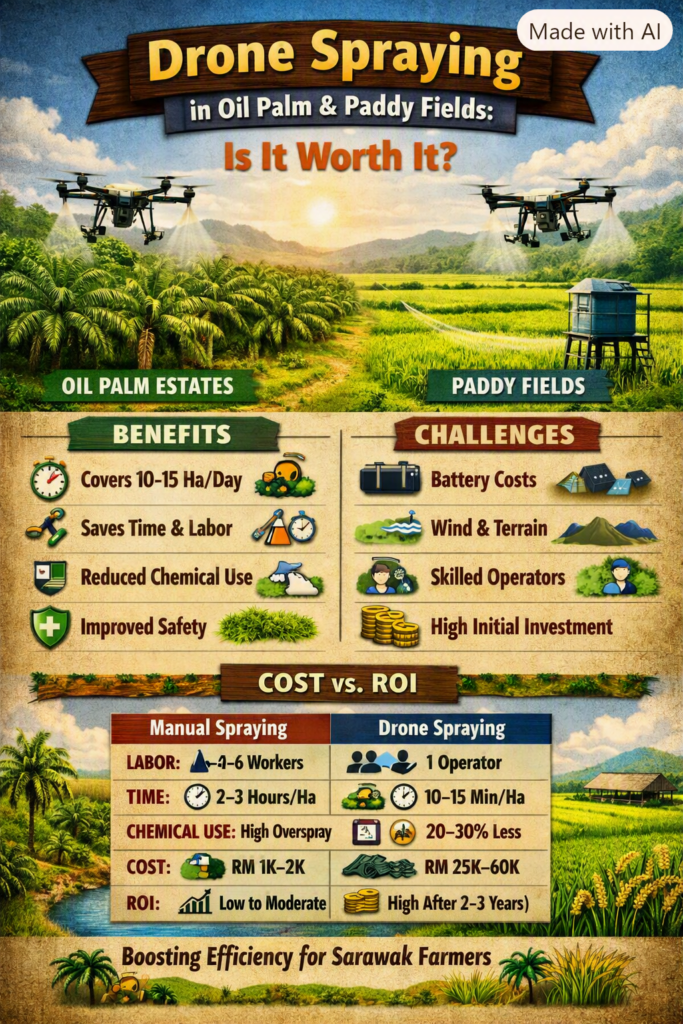
🌾 The Rise of Drone Farming in Sarawak
Sarawak’s agriculture is evolving fast — from traditional knapsack spraying to precision aerial application using drones. With vast oil palm estates and expanding paddy fields in regions like Serian, Betong, and Mukah, drones promise faster, safer, and more efficient crop management. But are they worth the cost?
⚙️ How Drone Spraying Works
Agricultural drones use GPS‑guided flight paths to spray fertilizers, pesticides, or foliar nutrients evenly across fields. Equipped with atomizing nozzles and variable‑rate controllers, they deliver precise droplet sizes and coverage.
Typical Drone Setup
| Component | Function |
|---|---|
| Spray Drone (10–30 L capacity) | Carries liquid payload and disperses via nozzles. |
| Battery Pack (Li‑ion) | Powers motors and pump for 15–25 minutes per flight. |
| Ground Station / App | Controls flight path, altitude, and spray rate. |
| GPS & Sensors | Ensure uniform coverage and obstacle avoidance. |
🌴 Oil Palm Estates: Efficiency vs. Terrain
✅ Advantages
- Access to difficult terrain: Drones can reach steep slopes and muddy areas where tractors struggle.
- Reduced labor dependency: One operator can cover up to 10–15 ha/day.
- Targeted spraying: Ideal for herbicide and foliar nutrient application around palm circles.
- Lower chemical exposure: Minimizes worker contact with pesticides.
⚠️ Challenges
- Canopy height: Mature palms (> 6 m) require higher spray pressure or multi‑angle nozzles.
- Wind drift: Droplet dispersion can be uneven in open plantations.
- Battery logistics: Frequent recharging needed for large estates.
- Initial cost: RM 25,000–RM 60,000 per unit depending on capacity and brand.
🌾 Paddy Fields: Precision and Productivity
✅ Advantages
- Uniform coverage: GPS mapping ensures consistent application across plots.
- Time savings: Sprays 1 ha in 10–15 minutes, compared to 2–3 hours manually.
- Reduced water contamination: Controlled droplet size prevents chemical runoff.
- Data integration: Drones can pair with NDVI sensors for crop health monitoring.
⚠️ Challenges
- Wind and humidity: Affect droplet evaporation and drift.
- Maintenance skill: Requires trained operators for calibration and software updates.
- Battery replacement: Adds recurring cost every 12–18 months.
💰 Cost–Benefit Snapshot
| Factor | Manual Spraying | Drone Spraying |
|---|---|---|
| Labor | 4–6 workers/ha | 1 operator/10 ha |
| Time | 2–3 hours/ha | 10–15 minutes/ha |
| Chemical Use | Higher (overspray) | 20–30% reduction |
| Safety | High exposure | Minimal exposure |
| Initial Cost | RM 1,000–RM 2,000 | RM 25,000–RM 60,000 |
| Long‑Term ROI | Moderate | High (after 2–3 years) |
🧩 Best Practices for Sarawak Farmers
- Start small: Pilot test on 5–10 ha before scaling up.
- Train operators: Attend DOA or MPOB drone certification courses.
- Use compatible chemicals: Choose low‑viscosity formulations for drone nozzles.
- Monitor weather: Avoid spraying during strong winds (> 10 km/h).
- Maintain regularly: Clean filters, calibrate pumps, and update flight software.
🌱 Is It Worth It?
For medium to large farms, drone spraying delivers clear advantages — faster operations, reduced chemical use, and improved worker safety. For smallholders, shared drone services or cooperatives can make adoption affordable. Ultimately, the value lies not just in speed, but in precision and sustainability — helping Sarawak’s agriculture move toward smart farming.
🏁 Closing Note
Agricultural drones are no longer futuristic gadgets; they’re practical tools reshaping how Sarawak’s oil palm and paddy farmers manage crops. With proper training and maintenance, drone spraying can cut costs, improve yields, and protect the environment — making it a worthy investment for the state’s next generation of agropreneurs.