
🌾 Why Fertigation?
Fertigation — the combination of fertilizer + irrigation — is transforming vegetable farming across Sarawak. By delivering nutrients directly through drip lines, farmers achieve:
- Higher yields (up to 30–50% increase compared to soil application)
- Precise nutrient control
- Reduced labor and fertilizer wastage
- Consistent growth even during dry spells
For crops like chili (Capsicum annuum) and eggplant (Solanum melongena), fertigation ensures uniform fruit size, better color, and longer shelf life — key for both local markets and export buyers.
🧱 Basic System Components
| Component | Function | Typical Cost (RM) |
|---|---|---|
| Water Tank (500–1000 L) | Stores nutrient solution | 250–400 |
| Mixing Tank (200–300 L) | Prepares fertilizer mix | 150–250 |
| Fertigation Pump (0.5–1 HP) | Pushes solution through drip lines | 400–800 |
| Mainline & Subline Pipes (PVC/PE) | Distributes water to rows | 300–600 |
| Drip Lines (16 mm) | Delivers nutrients to each plant | 0.30–0.50 per m |
| Filter Unit | Prevents clogging | 150–300 |
| Timer / Controller | Automates irrigation | 200–400 |
| Fertilizer Injector (Venturi or Dosatron) | Controls nutrient dosing | 250–600 |
| Shade Net / Polyhouse (optional) | Protects plants from heavy rain | 2,000–5,000 |
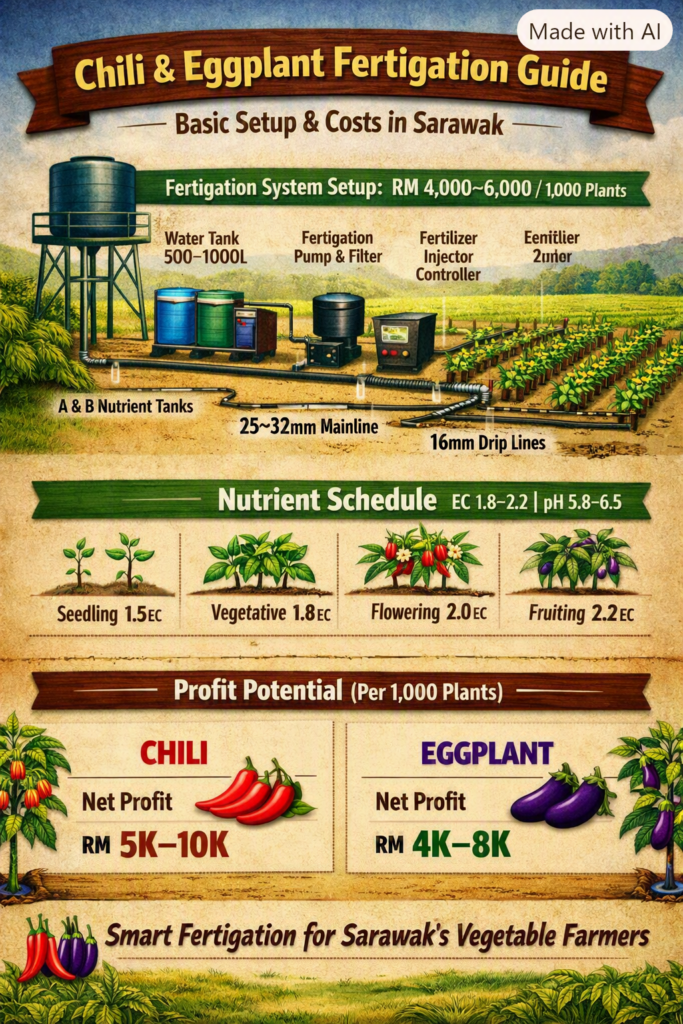
Estimated total setup (per 1,000 plants): RM 4,000–6,000 Costs vary depending on brand, pipe length, and whether automation is included.
🧩 Design Layout for Sarawak Conditions
1. Plot Size
- Recommended: 0.1–0.2 ha (¼–½ acre) for beginners.
- Plant spacing: Chili — 1.2 × 0.6 m, Eggplant — 1.5 × 0.8 m.
2. Tank Placement
- Elevated on a stand (1–1.5 m height) for gravity flow.
- Near power source or solar pump if off‑grid.
3. Mainline Design
- Use 25–32 mm PVC for mainline; 16 mm PE for sublines.
- Install flush valves at line ends for cleaning.
4. Drip Emitters
- Flow rate: 2–4 L/hour per emitter.
- One emitter per plant for chili; two for eggplant.
5. Fertilizer Mixing
- Use A/B tank system:
- Tank A: Calcium nitrate + iron chelate
- Tank B: Potassium nitrate + phosphates + micronutrients
- Maintain EC 1.8–2.2 mS/cm and pH 5.8–6.5 for optimal uptake.
💧 Nutrient Schedule (Example)
| Growth Stage | Duration | Key Nutrients | EC (mS/cm) |
|---|---|---|---|
| Seedling | 0–3 weeks | Nitrate nitrogen, calcium | 1.5 |
| Vegetative | 4–6 weeks | NPK (20‑20‑20) + micronutrients | 1.8 |
| Flowering | 7–9 weeks | High potassium (KNO₃) | 2.0 |
| Fruiting | 10 weeks + | Balanced NPK (15‑5‑30) | 2.2 |
⚙️ Maintenance Tips
- Flush drip lines weekly to prevent clogging.
- Clean filters every 3 days during heavy rainfall.
- Calibrate EC/pH meters monthly.
- Replace emitters every 12–18 months.
- Keep fertilizer tanks shaded to reduce algae growth.
💰 Profitability Snapshot
| Crop | Yield (per 1,000 plants) | Market Price (RM/kg) | Gross Return (RM) | Net Profit (RM) |
|---|---|---|---|---|
| Chili | 1,200–1,500 kg | 8–12 | 9,600–18,000 | 5,000–10,000 |
| Eggplant | 1,800–2,200 kg | 4–6 | 7,200–13,200 | 4,000–8,000 |
🌱 Closing Note
Fertigation is no longer limited to large commercial farms — it’s now accessible to Sarawak’s smallholders through modular systems and local suppliers. With proper design, monitoring, and nutrient management, chili and eggplant fertigation can deliver consistent yields and strong returns even under unpredictable tropical weather.
SarawakAgro.com continues to promote smart farming practices that combine technology, sustainability, and profitability for the state’s growing agro‑community.